
On the night of March 6, 2026, the federal government approved a staggering Rs. 55 per litre increase in the prices of petrol and High-Speed Diesel (HSD). With petrol now retailing at Rs. 321.17 and diesel at Rs. 335.86, the nation is grappling with the immediate inflationary fallout.
Table of Contents
ToggleHowever, behind the “petrol bomb” headlines lies a complex web of legal frameworks, regulatory mandates, and international commitments. At Robes and Gavel Legal, we believe that understanding the how and why behind these price hikes is essential for businesses and citizens to navigate the current economic volatility.
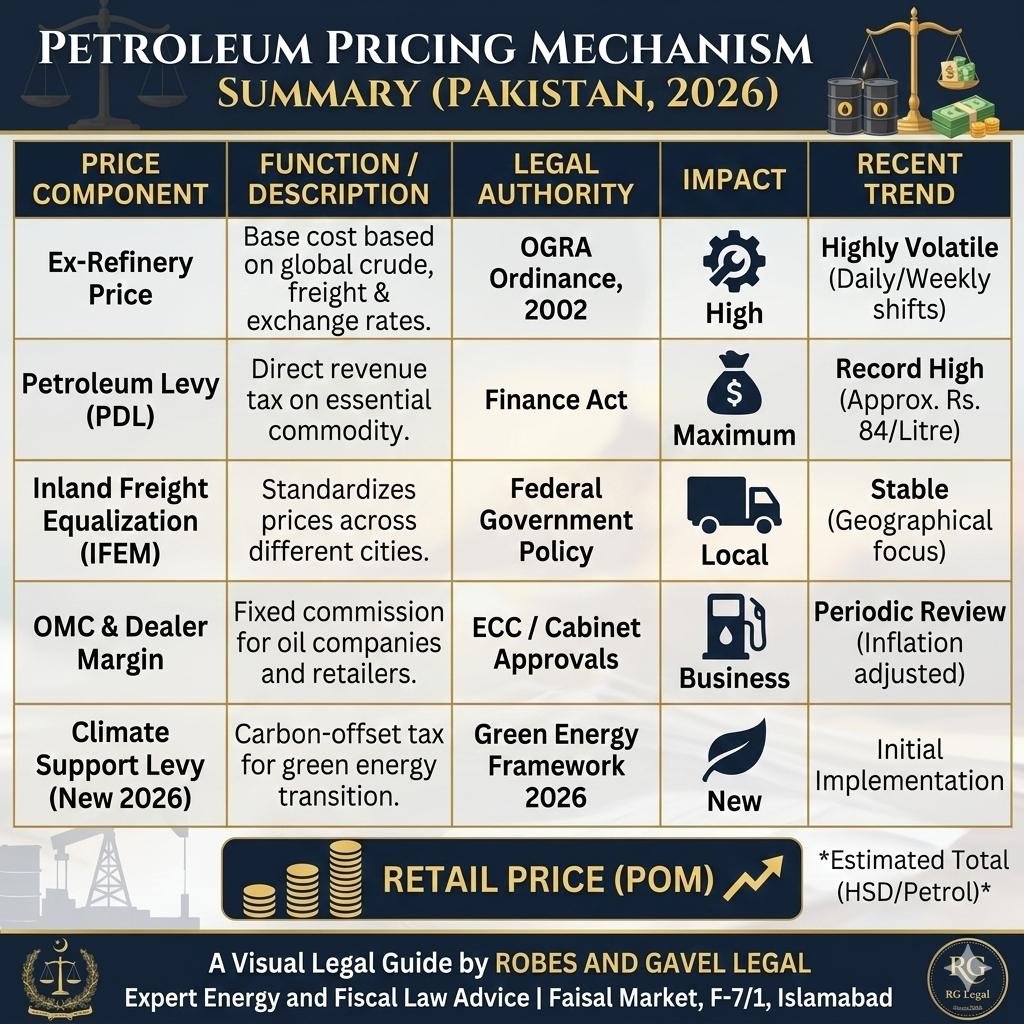
The Regulatory Architecture: Who sets the price?
The legal authority to determine petroleum prices is a bifurcated process involving the Oil and Gas Regulatory Authority (OGRA) and the Petroleum Division.
- The OGRA Ordinance, 2002: Under this law, OGRA’s primary role is to compute the “Import Parity Price” based on international benchmarks (Platts/Brent crude), freight costs, and the exchange rate of the PKR against the USD.
- The Government’s Prerogative: Contrary to popular belief, OGRA does not “decide” the final price at the pump. It submits a summary to the Federal Government, which then exercises its executive power to add the Petroleum Development Levy (PDL) and distributor margins.
The "Strait of Hormuz" Factor & Legal Emergency Measures
The current price hike is not merely a fiscal adjustment; it is a response to geopolitical supply disruptions in the Middle East. Legally, the government is operating under energy contingency plans reviewed by the Cabinet in early March 2026.
We are seeing a major shift in the legal timeline of pricing:
Weekly Price Reviews:
To prevent “inventory losses” for Oil Marketing Companies (OMCs) and to reflect global volatility faster, the government is considering moving from fortnightly (15-day) to weekly pricing.
The Petroleum Levy Cap:
The Finance Act currently empowers the government to charge a substantial levy. As of early 2026, the Petroleum Levy has reached record highs (approx. Rs. 84 per litre), acting as a primary revenue generator to bridge the fiscal deficit and meet IMF mandated targets.
The Fifth Schedule Protection: A Shield for E&P Companies
A critical legal development occurred in late January 2026, when the Federal Constitutional Court (FCC) issued a ruling that has direct implications for the petroleum sector.
While the Court generally upheld high taxes on the corporate sector, it granted a specific “limited relief” to Exploration and Production (E&P) companies.
The FCC ruled that any tax or levy including the Super Tax cannot exceed the caps agreed upon in the Petroleum Concession Agreements (PCAs) signed between the President of Pakistan and these companies under the Regulation of Mines and Oil fields and Mineral Development Act, 1948.
This is a victory for the sanctity of contracts. It ensures that while consumers face the brunt of retail prices, the companies investing in Pakistan’s energy security are protected by the sovereign guarantees provided in their concessions.
Understanding the Cost Breakdown (March 2026 Estimates)
As prices soar, we anticipate a new wave of litigation in the High Courts focusing on:
1. Hoarding & Supply Regulation: The government has issued strict directives to provincial authorities to prosecute hoarders. At Robes and Gavel, we advise retailers and OMCs to maintain “historical track record” logs to defend against arbitrary raids.
2. Force Majeure Claims: With major suppliers like QatarEnergy recently issuing force majeure notices due to regional conflict, many local supply contracts are being triggered for legal review.
3. The “Right to Affordable Energy”: Constitutional petitions are being prepared to challenge the high PDL, arguing that excessive taxation on an essential commodity violates the fundamental right to life and livelihood under Article 9.
Conclusion: A Strategic Outlook
The era of cheap fuel is gone, and the era of regulated volatility is here. For our industrial clients, the focus must shift from absorbing costs to legal mitigation ensuring that your energy contracts have robust price variation clauses and that your “Bulk Power Consumer” status is leveraged to bypass inefficient supply chains.